

How Sharks Hunt Using Electroreception
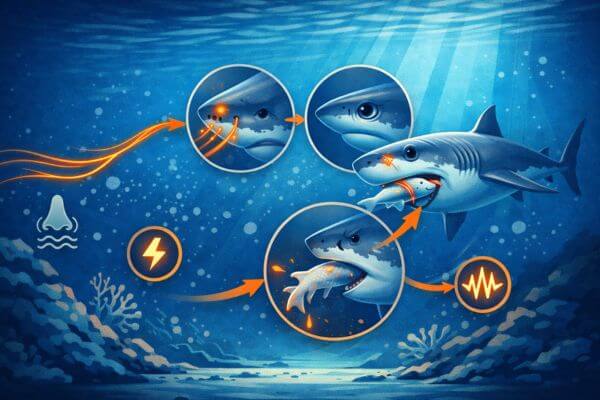
How Sharks Hunt involves using multiple senses, including electroreception, which provides sharks with an additional way to locate prey at close range. This “sixth sense” allows sharks to detect tiny electrical impulses produced by muscle contractions and heartbeats, even in murky water or when prey is buried beneath sand, enabling precise strikes when other senses are limited.
Electroreception works by sensing the electrical signals generated by the heartbeat and muscle movements of fish and other marine animals, helping sharks locate and identify prey hidden in low-visibility environments or underwater burrows.

What Is Electroreception, and Why Is It Called a “Sixth Sense”?
Electroreception is the ability of certain animals, including sharks, to detect weak electrical fields in their environment. It is often called a “sixth sense” because it allows sharks to perceive signals that cannot be detected through sight, smell, sound, taste, or touch.
All living animals produce tiny electrical fields when their muscles contract and their hearts beat. In saltwater, these electrical signals travel efficiently through the surrounding environment. Sharks can sense these signals using specialised organs called the Ampullae of Lorenzini, located around the snout and head.
These organs detect extremely faint electrical impulses, making electroreception especially useful in poor visibility, such as in darkness, murkiness, or sandy conditions where other senses become less effective. Through this sixth sense, sharks can locate hidden, motionless, or camouflaged prey on the ocean floor.
How Sharks Hunt Using Electroreception
Locating Hidden Prey
Even though a prey animal may have its body fully buried under a bed of sand or rocks in a cave, it will still produce very small amounts of electricity due to muscle contractions (even if they are at rest) and heartbeats. Even though this prey animal is out of sight, it still produces enough electric current to travel through the saltwater that surrounds it. Sharks can detect very small amounts of electric current using the ampullae of Lorenzini and therefore locate prey that has been hiding from them. When the water is cloudy, there is little light available, or when a shark is close to capturing its prey, this ability to locate prey without being able to see it becomes extremely valuable.
How Sharks Hunt During the Final Attack Stage
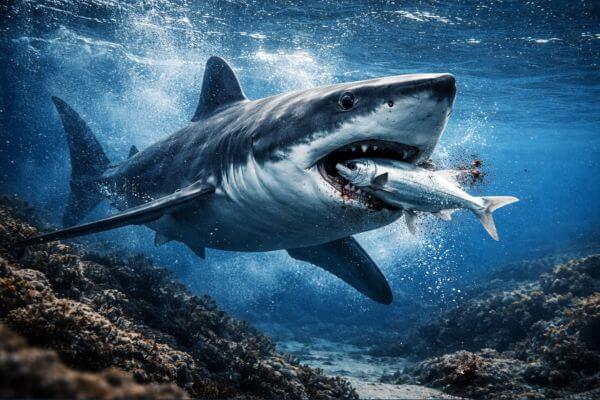
How sharks hunt becomes the most accurate near the end of the encounter. At that point, electroreception allows sharks to find prey at short range. When a predator is about to catch its prey, other ways the shark can sense its prey (such as sight and smell) are less reliable because of turbulence in the water, poor light, and the prey’s quick movements. In addition, electroreception provides a valuable means for sharks to track their prey when visual and olfactory methods have reached their limits.
The shark detects these electric impulses using specialised sensory organs called ampullae of Lorenzini. The ampullae of Lorenzini allow the shark to follow the prey’s electrical impulses and orient itself in preparation for a strike. This means that sharks can use electroreception to complete the hunt when the prey is covered in sand or buried under sediment.
Navigation and Orientation
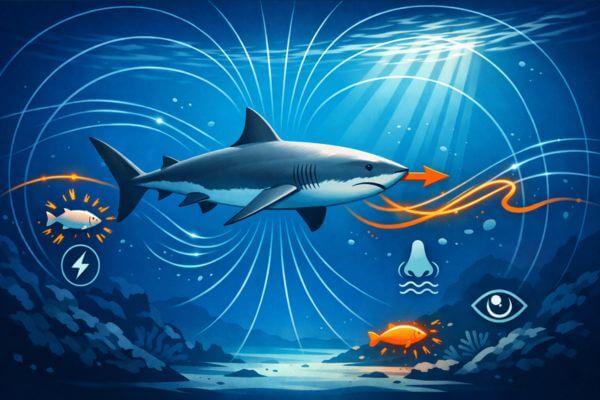
While most researchers agree that electroreception helps sharks locate prey, there is evidence that it also plays an important role in navigation, particularly during long-distance migration.
Research has shown that sharks can detect very small differences in Earth’s electric and magnetic fields, which may allow them to determine their exact position while travelling long distances.
Scientists believe that sharks’ electroreceptors may detect the electrical impulses generated by the movement of water (which carries dissolved minerals) through Earth’s magnetic field. If true, these impulses would likely provide sharks with directional information and possibly even tell them how far away they are from a specific point on the globe.
The ability to use electroreception to sense direction and possible location while migrating long distances might explain why many species of sharks exhibit such great navigational abilities. However, further research is needed to fully understand the extent to which electroreception contributes to this ability.

How Sharks Hunt: Key Anatomical Features Involved
Specialised electro-sensory organs called ampullae of Lorenzini make up the jelly-filled canals found on the shark’s skin (especially at the snout and head) and have openings for sensory nerve endings.
The jelly-like insides of the canals allow sharks to feel the very slight electrical impulses coming through the surrounding water from the sensory cells. Sharks can detect electrical impulses in water at levels of 5 nV/cm or less, an incredibly high sensitivity for all sensory systems found in the animal kingdom.
Because of this incredible sensitivity, sharks can detect the movements of their prey, the heartbeat of their prey, and small environmental differences that may not be detected by their other senses.
Why Is This Important for Shark Behaviour?
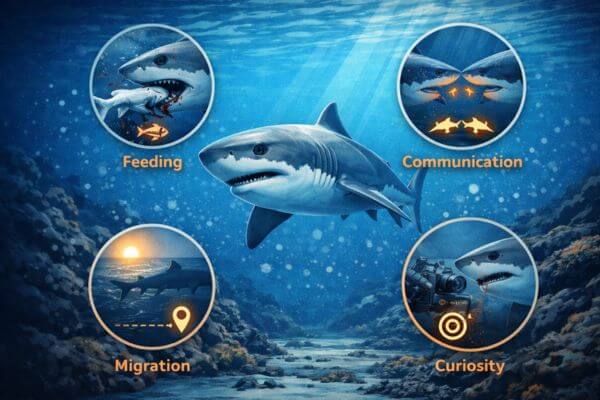
How Sharks Hunt is closely linked to electroreception, which plays an important role in shark behaviour, helping them locate and capture prey. This sensory ability allows sharks to detect prey even when it is stationary, hidden, or out of sight, meaning prey cannot rely solely on camouflage or stillness to avoid detection.
Because sharks can find and capture prey in poor light, low visibility, or along the ocean floor, where sight is limited, they can hunt in environments that many other predators cannot exploit.
As a result, sharks adapt their movement patterns, hunting strategies, and timing to exploit these challenging conditions. Their success as predators is not based on speed or physical strength alone, but on a powerful combination of advanced sensory systems that allow them to survive and thrive in complex marine ecosystems.

For Marine Adventurers (Shark Cage Diving and Snorkelling)
Understanding how sharks perceive their environment will help Marine Adventures understand how sharks behave when they share the water. Sharks rely on many fine-tuned senses to navigate their environment; therefore, calm, calculated movement is a key part of creating safe and respectful shark encounters.
When divers and snorkelers remain calm and avoid sudden motions and excessive splashing, it reduces the amount of unnecessary sensory stimulation to a curious shark. This awareness promotes both safe interactions with sharks and an understanding of how sharks navigate their environment.
Shark diving has much greater significance when you realise that you are viewing a perfectly adapted predator, working exactly as nature has intended; calmly, efficiently, and in harmony with its environment.
Do Sharks Use Electroreception to Detect Humans or Other Large Animals?
Sharks detect electrical impulses best when they are relatively close (less than one meter) to an object of interest. The primary time electroreception is utilised for detecting prey is immediately before catching it; typically, after a shark has approached its prey.
Electrical signals that humans produce through swimming are dissimilar to the signals produced by normal prey. Movement of humans produces signals that do not resemble the weaker, rhythmic signals of injured, small, or hidden prey. Therefore, electroreception cannot be relied upon to prompt a shark to begin a hunt for humans, nor can it be solely depended upon to prompt a shark to begin a hunt for other larger animals.
Therefore, in almost all instances, electroreception is secondary to the use of a shark’s other senses to determine whether an unknown large object is food, and is used primarily as a backup system to aid a shark in determining if an object is edible when the shark is very close to the object.
Where Around the Shark’s Body Are the Sensors Located?
The majority of electroreceptors in sharks are located on the upper portion of the snout, the top of the head and the underside of the head. The aforementioned areas contain numerous pores, which resemble small, dark spots when viewed at close range.
Each of these pores serves as an entry point for an ampulla of Lorenzini (a jelly-filled tube) that extends to sensory cells beneath the skin. Thus, the placement of the electroreceptors enables sharks to view both the water column and the seafloor, as well as surrounding objects, as they move through the water column, providing highly detailed electrical information about the target area upon initial detection.
Are All Sharks Equally Good at Electroreception?
No. There is a lot of variability in terms of number, placement, and sensitivity of electroreceptors among shark species. Species of sharks that primarily eat prey that are hiding from view (such as fish swimming near the ocean floor) are likely to be able to find their prey using an electroreceptor system that is much more developed than that of other sharks.
Sharks, which are likely to be eating prey such as stingrays buried beneath the sand, are very reliant on electroreception for finding their prey and often have a larger number of electroreceptors around the snout of the shark so that they can accurately find the electrical signal that would indicate the presence of the stingray. Sharks that are hunting fast-moving prey rely more on electroreception and less on sight, speed, etc.
Is Electroreception Enough For How Sharks Hunt?
No. How sharks are able to find prey is dependent upon how all their senses work in conjunction (together) as opposed to one sense alone. They use all five of their senses, including the sense of smell, hearing, sight, the lateral line system and electroreception, to find prey and ultimately catch it.
The sense of smell and hearing help sharks locate prey at longer ranges, track down those scents, and detect the low-frequency sounds that prey emit. The sight and lateral line systems then assist in tracking the movement and direction as the shark closes in on the prey. Electroreception is used for the final and most crucial stage of finding prey, typically at close range, as well as when prey is hiding, motionless, or camouflaged.
Electroreception does not replace the other senses but assists in fine-tuning the hunting process. It allows sharks to strike precisely when other sensory information becomes limited or unreliable.
How Does This Tie In With Shark Diving and Marine Adventure off Durban?
Shark cage diving with Durban Shark Diving does not just provide an exhilarating experience; it also presents the rare possibility of viewing apex predators using highly developed sensory systems (including electroreception), which allow them to locate prey and avoid predators.
Your experience will be enhanced by understanding how sharks perceive and use their surroundings, as you observe the slow, deliberate movements of the sharks surrounding the cage and see how they read electrical cues, changes in water movement, and subtle environmental shifts, rather than responding either randomly or aggressively. Understanding this, you can see how shark behaviour is controlled and, therefore, how important it is to maintain calm and respectful human presence during all dives.
Additionally, your experience will become much deeper and more meaningful when you understand that you are experiencing a natural predator acting as designed by evolution. Shark diving off Durban enables marine adventurers to observe the delicate predator-prey balance in action and to develop greater respect for these creatures and the ocean environment they inhabit.
Are you ready to turn shark curiosity into real-world exploration? Durban Shark Diving offers a complete shark cage-diving experience in South Africa, combining thrilling ocean predator encounters with professionally guided marine adventures. Whether you’re a first-time diver or a seasoned ocean enthusiast, our experiences give you the chance to observe sharks in their natural environment with safety, respect, and education at the core.